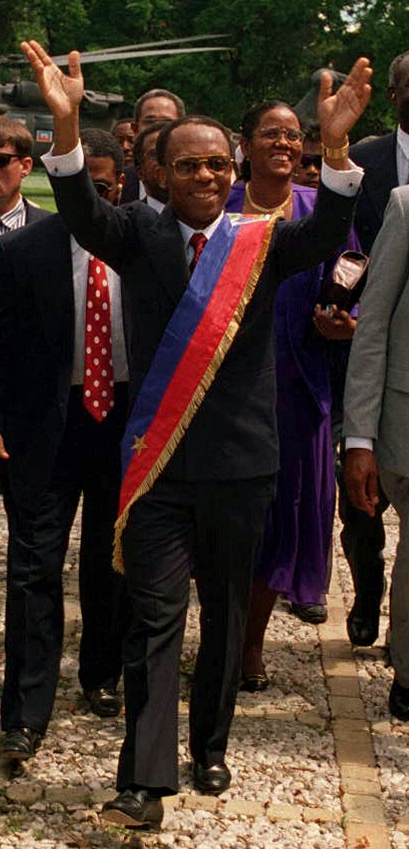
Jean-Bertrand Aristide was the priest-politician whose rise transformed post-Duvalier Haiti, emerging from liberation theology, grassroots church work, and anti-Macoute struggle to win the 1990 presidential election by an overwhelming margin.
Fatton treats him as the embodiment of a genuine popular-democratic rupture and also as a deeply contradictory political actor — prophetic, messianic, anti-elite, suspicious of party institutions, and increasingly constrained by U. S. -managed restoration and structural adjustment. He was overthrown in the coup of September 1991, restored under U. S. military protection in 1994, and remained the central pole of Haitian politics into the 2000s before being removed again in 2004 — an event that opened the institutional order of NGOs, donors, and MINUSTAH that defined the post-Aristide period. Dubois reads his rise as part of the longer afterlife of 1804: a moment when the poor and excluded majority again entered national politics, only to be met by military overthrow and foreign management.
In the ScholarshipHow historians have read this figure.
How historians and scholars have interpreted this figure across different analytical traditions.
Trouillot's Haiti: State Against Nation, written before the first coup against Aristide, provides the structural framework that subsequent analysts would use to understand Aristide's fate. Trouillot's argument that the Haitian state has historically been an apparatus of extraction incapable of genuine representation anticipates the dynamics that would define Aristide's presidencies: a popular leader whose democratic mandate collided with an institutional structure built to prevent popular power from translating into actual governance. The military, the economic elite, and eventually the international community all appear in Trouillot's structural account as stakeholders in the state's anti-nation logic — interests that Aristide's popularity threatened but his institutional position could not overcome.
Trouillot's structural analysis anticipates Aristide's fate — a popular leader whose democratic mandate collided with an institutional apparatus built to prevent popular power from translating into governance, reinforced by military, elite, and international stakeholders.
Farmer's The Uses of Haiti reads Aristide's political career through the lens of international politics — specifically how the U.S. government, the Haitian elite, and international financial institutions combined to undermine Aristide's elected government both in 1991 (when the military coup removed him) and in 2004 (when the second removal occurred). Farmer's activist-scholarly perspective, grounded in his medical work in Haiti's central plateau, makes him attentive to how the international community's treatment of Aristide was inseparable from broader questions about whether Haiti's poor majority would be allowed to exercise political power. His account situates the coups and the international pressure against Aristide within the structural argument that Haiti's poverty is not an accident but a product of both domestic elite extraction and international political and economic intervention.
The coups against Aristide were not aberrations but expressions of the structure Farmer identifies — domestic elite, military, and international financial and political interests combining to prevent Haiti's poor majority from exercising political power.
Fatton's The Roots of Haitian Despotism devotes substantial analysis to Jean-Bertrand Aristide as the figure who embodied both the promise and the failure of Haitian democratic politics in the post-Duvalier period. Fatton reads Aristide's trajectory — liberation theology priest, elected president, coup victim, returned president, second elected president, second coup victim — as evidence of the structural constraints that the predatory state imposed on democratic transformation. Aristide's popularity was genuine; his electoral mandates were real; but his government's inability to consistently translate popular support into institutional change, his eventual accommodation of the political culture he had criticized, and his downfall through elite-military coalitions supported by international powers all appear in Fatton's account as the systemic pattern reasserting itself against democratic possibility.
Aristide's trajectory — twice elected, twice removed — demonstrates the structural constraints predatory politics imposes on democratic transformation: genuine popular support unable to overcome elite-military-international coalitions defending the existing order.
TimelineAcross the historical record.
- 1991
President of Haiti
Elected president in December 1990 with an overwhelming majority; overthrown in coup of September 1991, restored in 1994, served again 2001-2004.
- 1991-09-30
1991 Coup Haiti
Was overthrown by military coup in September 1991, beginning three years of exile and the repression that followed.
- 2004-02-29
2004 Coup Haiti
Was removed from power again in 2004; his departure opened the institutional order of NGOs, donors, and MINUSTAH that defined the post-Aristide period.
RelationshipsPeople connected to this life.
- OpposedFrançois Duvalier
His Lavalas movement and liberation theology politics were a direct rupture with the Duvalierist order and its Macoute networks.
- OpposedJean-Claude Duvalier
Emerged from the anti-Duvalier grassroots church and liberation theology networks that formed the opposition to the Duvalier dictatorship.