The history people most need is the history that is hardest to hold.
The Haitian Revolution is one of the most consequential events of the modern world: a self-emancipated nation founded by formerly enslaved people, a constitutional rupture the Atlantic world spent two centuries trying to contain. Its archive is correspondingly difficult: scattered across empires, written in several languages, and told from positions that do not agree on what happened.
For most readers, that archive is unreachable. Researchers who can read it spend years assembling fragments by hand. Rasin makes that assembly visible, so a curious reader, a graduate student, or a descendant working on family history can move through the same corpus with the disagreements and absences shown plainly.
We are not building a chatbot for history. We are building an archive that helps readers compare sources, with citations, uncertainty, and disagreement kept visible.
Five commitments we hold ourselves to.
Source-first
No claim is repeated without a path back to a primary or scholarly document. The text you see is always traceable.
Multi-perspective
Colonial, Haitian, diplomatic, primary, and scholarly voices are tagged distinctly. We do not flatten them into a single narrator.
Show your work
AI summaries should list the passages they drew on. Citation status and disagreement labels appear only where supporting data exists.
Accountable
Corrections are reviewed without erasing the original record. Public errata tracking is still being built, so this page does not publish counts yet.
Limits made visible
OCR errors, archival silences, language gaps, and model uncertainty are surfaced as part of the record, not hidden behind polish.
What traceability means in Rasin.
Source pluralism
Rasin draws from a growing corpus across Haiti, France, the U.S., and the Caribbean. Source-authority metadata is displayed where available, and coverage is being expanded across the live source registry.
Bias is surfaced before it misleads
Perspective tags follow documents into search results, claims, and graph links. When one perspective dominates retrieval, the interface warns the reader instead of pretending the corpus is neutral.
Claims are verified against passages
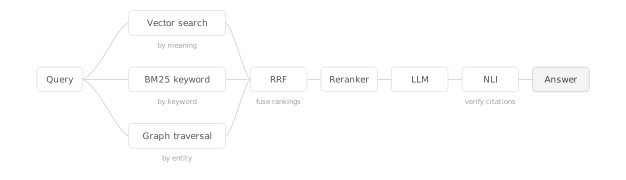
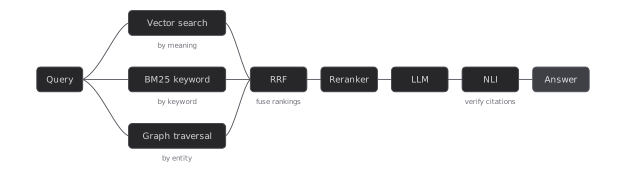
Rasin pairs generated answers with citations and runs support checks so a quoted passage has to actually ground the factual claim it is attached to.
Model routing is explicit
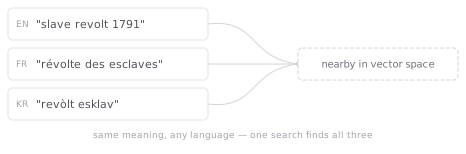
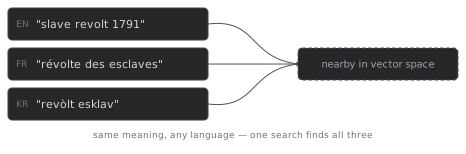
OCR, embeddings, reranking, citation verification, entity extraction, and answer synthesis are tracked as separate model roles. For each role, Rasin documents the provider, retention boundary, and review status.
A color key for source perspective.
Rasin uses color to help readers recognize the kind of source behind a result before they read the claim. When perspective tags are available, the same color follows that source through search, people, events, documents, and graph links.
The colors are context cues, not rankings. They distinguish colonial administration, Haitian institutions and vernacular traditions, foreign diplomacy, scholarship, and primary records so readers can compare evidence with more care.
Colonial and French state
Blue marks royal ordinances, planter correspondence, colonial newspapers, and administrative reports produced inside colonial or French state systems.
Haitian state, oral, vernacular
Gold marks constitutions, presidential papers, Kreyòl testimony, Haitian sacred practice, oral tradition, and Haitian intellectual work.
Foreign-state diplomatic
Green-gray marks U.S., British, Spanish, and other diplomatic dispatches, helping readers separate outside observation from Haitian self-description.
Scholarship and criticism
Purple marks historical, philological, cultural, and digital humanities scholarship, presented as interpretation rather than the source record itself.
Witness and record
Deep green marks first-person testimony, legal records, manifests, maps, and period documents kept close to their original context.
How sources become traceable claims.
A document enters Rasin through a staged pipeline. Some steps are automated, some are manual, and launch-facing claims should remain reviewable before they are presented as settled.
Acquire
Source documents are digitized or imported from partner archives and public collections with original URLs and provenance metadata retained.
Transcribe
OCR and period-aware extraction convert scans into text, while uncertain glyphs, damaged pages, and language issues remain flagged.
Tag
People, places, dates, claims, source types, and perspectives are structured for review and downstream retrieval.
Cross-reference
Claims are linked to existing entities and related passages. Conflicts are surfaced, not silenced.
Publish
Reviewed material can go live with citation paths and review status. Persistent identifiers and public version metadata remain launch standards until product records back them.


Three statuses, one rule: never a single voice.
Claim status is an editorial standard, not an automatic verdict. A claim should be labeled only when the supporting passages and review context are visible enough to justify that label.
Attested
Independent sources support the claim, and the passages doing that work are visible.
Contested
Sources disagree, often along perspective lines. Rasin should display the positions rather than choose a winner for the reader.
Disputed
A named scholar or source tradition challenges the claim. The challenge should be linked, and the original record preserved.
No illustrative claim is shown until it exists in the product.
Worked examples should come from the live knowledge graph or stay out of the launch page. Until then, this section describes the review rule rather than inventing a case study.
The claim stays attached to the document, passage, and source metadata that support it.
Attested, contested, and disputed labels are used only when the evidence is visible enough to review.
If support is missing or the graph disagrees with the page copy, the claim is removed or marked as unfinished.
What the model does, and what it does not.
Model boundaries
Rasin uses language models for transcription assistance, entity extraction, retrieval support, and grounded summary synthesis.
The model never invents a source, never decides a claim status, and never resolves a contested historical question by itself.
Where the corpus is silent, the page stays silent. Model roles and evaluation notes are documented for review where available; public release notes are still in build-out.
Signed review
Reviewed pages will name the editors who signed off. Names are not decorative; they are accountable parties.
We are forming an editorial board with domain knowledge in Haitian and Caribbean history, African diasporic religions and belief systems, Atlantic legal history, linguistics, and digital humanities.
Corrections should be part of the record.
The public correction workflow is still being built. Today, corrections and contested claims are reviewed manually; the future goal is a visible record that preserves the original reading, reason for change, and reviewer who accepted it.
We will publish public counts and versioned citation metadata only after that workflow is live.
Public errata tracking is not live yet.
No errata counts are shown here until they come from the product itself. This page should document the standard we are building toward, not imply completed review volume.
For now, send corrections, contested readings, missing citations, or source questions directly to the team.
Email contact@studio1804.org