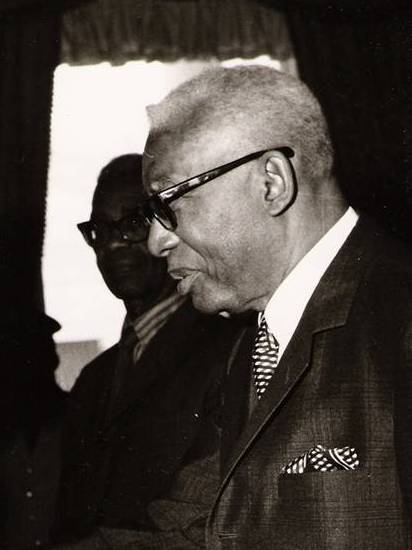
François Duvalier was a physician, ethnological writer, noiriste intellectual, and the dictator who ruled Haiti from 1957 to 1971.
He emerged from the same post-occupation world that produced Jean Price-Mars and the ethnological movement, but with Lorimer Denis and the Griots current he transformed cultural revaluation into the racially charged political ideology of noirisme, claiming to speak for the Black majority while building a new ruling bloc around the Black middle class and executive state. His rise in 1957 was the outcome of the political fractures left by the occupation's aftermath, the Revolution of 1946, Estimé's reformist opening, and Magloire's military order. In power he destroyed rival power centers, deployed the Tonton Macoutes as a paramilitary instrument of terror, and appropriated music, carnival, Rara, and public ritual as tools of patronage and symbolic control — formalizing Haiti's long political crisis rather than resolving it.
In the ScholarshipHow historians have read this figure.
How historians and scholars have interpreted this figure across different analytical traditions.
Nicholls's From Dessalines to Duvalier reads François Duvalier as the culminating figure of the noiriste political-intellectual tradition — a physician, ethnologist, and politician whose intellectual formation in the Griots movement and his collaboration with Lorimer Denis had prepared the ideological apparatus that his dictatorship deployed. Nicholls traces the long genealogy of noirisme from its 19th-century roots through Price-Mars's ethnological recovery of Haitian Africanity to the political program that Duvalier operationalized: Black political power achieved through the capture of the state apparatus, the displacement of the mulâtre elite, and the mobilization of a Black masses rhetoric that legitimized personal dictatorship. Nicholls argues that Duvalierism represents what happens when noirisme — the intellectual claim that Haiti's Black majority deserved political power — is captured by a political entrepreneur willing to use state terror to maintain it.
Duvalier represents what happens when noirisme is captured by a political entrepreneur willing to use state terror — the intellectual tradition's legitimate claim that Haiti's Black majority deserved power operationalized as personal dictatorship.
Trouillot's Haiti: State Against Nation reads Duvalierism as the most extreme expression of the structural tendency he identifies throughout Haitian history: a state that extracts from rather than represents the nation. Trouillot argues that Duvalier did not invent this structure but perfected it — building on the state apparatus that Boyer, Geffrard, and the succession of 19th- and early 20th-century governments had constructed and using it to simultaneously represent Black popular aspirations and destroy the popular movements that had given those aspirations political form. The Tonton Macoutes, the elimination of the army, the destruction of civil society — these appear in Trouillot's account not as Duvalier's unique innovations but as the amplification of a structural logic that the Haitian state had embodied from its foundation.
Duvalier didn't invent the state-against-nation structure but perfected it — using the apparatus that centuries of Haitian governments had built to simultaneously represent Black popular aspirations and destroy the popular movements that had given those aspirations form.
Fatton's The Roots of Haitian Despotism situates Duvalier within his broader argument about the structural determinants of Haitian authoritarianism — reading the dictatorship not primarily as a product of noiriste ideology (Nicholls's emphasis) or state extraction logic (Trouillot's emphasis) but as the expression of a political culture of predation that the political class across color lines had cultivated. Fatton argues that Duvalier's genius was his ability to build a clientelist machine that operated through fear and loyalty simultaneously — the Tonton Macoutes as both enforcers and beneficiaries of a patronage system that gave the poor access to small advantages while terrorizing the population into compliance. His comparative framework situates Haitian predatory politics within the broader pattern of postcolonial authoritarianism rather than treating it as Haitian exceptionalism.
Duvalier's genius was building a clientelist machine operating through fear and loyalty simultaneously — the Tonton Macoutes as both enforcers and beneficiaries of predation, giving the poor access to small advantages while terrorizing the population.
TimelineAcross the historical record.
- 1946-01
Revolution of 1946
His rise was shaped by the political fractures opened by the 1946 revolution and the subsequent crisis of civilian legitimacy.
- 1957
President of Haiti (dictator for life)
Ruled Haiti from 1957 until his death in 1971, dismantling rival power centers and deploying the Tonton Macoutes as a paramilitary force.
RelationshipsPeople connected to this life.
- OpposedDaniel Fignolé
Both were competing inheritors of the noiriste political current after 1946; Duvalier outmaneuvered Fignolé's labor populism to seize power in 1957.
- Allied withLorimer Denis
Co-authored the Griots movement with Denis, turning cultural revaluation into the politically charged ideology of noirisme.