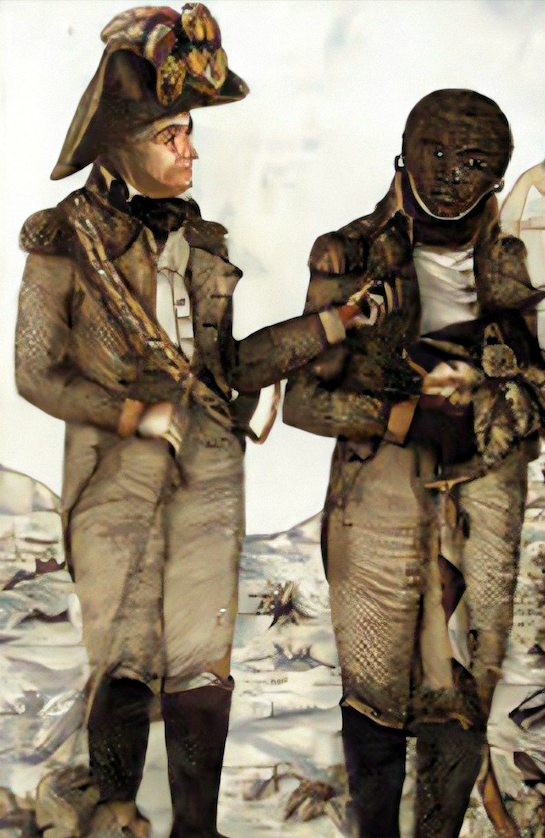
Étienne Laveaux was the French republican officer who rose from lieutenant-colonel of the dragons d'Orléans to become governor of Saint-Domingue after the arrest of Sonthonax and Polverel.
He publicly defended men of color in 1792 and famously refused British bribery during the defense of Port-de-Paix, styling himself a Spartan defender of the republic. His alliance with Toussaint Louverture after 1794 — when Toussaint placed himself under Laveaux's command upon switching to the French side — made republican emancipation viable in the North, though Toussaint quickly learned to operate beside and eventually above him. Laveaux's conflict with the free-colored officer Jean-Louis Villatte (the Villatte Affair of 1796) illustrates how unstable the republican coalition remained even after abolition.
In the ScholarshipHow historians have read this figure.
How historians and scholars have interpreted this figure across different analytical traditions.
Dubois's Avengers of the New World reads Étienne Laveaux as the French republican governor whose close alliance with Toussaint L'Ouverture — culminating in his public declaration of Toussaint as the 'black Spartacus' prophesied by Raynal — represented the republic's most genuine engagement with the revolutionary potential of emancipation. Dubois situates Laveaux within the broader account of how the French republic's emancipation decree of 1794 transformed the political landscape of Saint-Domingue, creating alliances between metropolitan representatives and formerly enslaved military leaders that neither the planters nor the British had anticipated. Laveaux's departure for France in 1796, with Toussaint's support, marks in Dubois's telling the moment when Toussaint took effective control of the colony — a transition that Laveaux facilitated by recognizing the political reality his alliance with the formerly enslaved had helped create.
Laveaux's declaration of Toussaint as 'the black Spartacus' represented the republic's most genuine engagement with emancipation's potential — and his facilitated departure in 1796 marked the moment Toussaint took effective control of Saint-Domingue.
Bell's Toussaint Louverture: A Biography reads the Laveaux-Toussaint alliance as one of the most consequential political relationships of the revolutionary period — a French governor who genuinely believed in republican emancipation working with the formerly enslaved general who understood that the republic's principles could be used to advance the interests of the formerly enslaved. Bell traces how Toussaint managed his relationship with Laveaux — cultivating the governor's trust, using his endorsement to consolidate authority, and ultimately ensuring his departure in a way that left Toussaint as the dominant power in Saint-Domingue without the rupture that a direct conflict would have required.
The Laveaux-Toussaint alliance was a relationship Toussaint managed strategically — cultivating the governor's genuine republican commitment while ensuring a succession of authority that left him dominant without rupture.
TimelineAcross the historical record.
- 1791
The Suisses
Connected to the Suisses crisis in the North Province political landscape.
- 1793
Governor of Saint-Domingue
Became governor after the arrest of Sonthonax and Polverel; defended the republic and allied with Toussaint Louverture to preserve emancipation in the North.
- 1796-03-20
Villatte Affair 1796
Laveaux was the target of Villatte's coup attempt in 1796; Toussaint intervened to restore him.
RelationshipsPeople connected to this life.
- OpposedGeorges Biassou
Biassou commanded Spanish-aligned forces in the North (Gros-Morne, Plaisance, Acul, Limbe) that Laveaux fought against before Toussaint's switch to the French side.
- OpposedJean-Louis Villatte
Clashed with Villatte in the Villatte Affair of 1796, illustrating the instability of the republican coalition in the North even after abolition.
- Allied withToussaint Louverture
Toussaint placed himself under Laveaux's command in 1794 upon joining the French side; Laveaux served as both ally and political stepping stone for the rise of the Louverturian state.