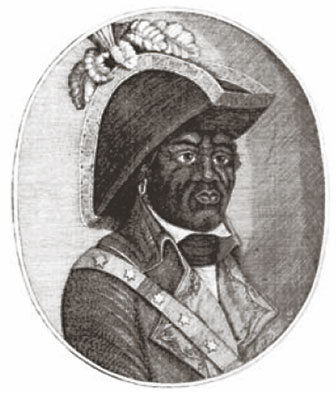
Georges Biassou was one of the five main leaders of the August 1791 uprising, enslaved as a sugar refiner and then by the Pères de la Charité hospital in Cap-Français.
More volatile and spiritually theatrical than his co-commander Jean-François Papillon, Biassou styled himself 'Governor General of the Conquered Territories,' combined Vodou ceremony with military strategy (promising soldiers they would return to Africa if killed in battle), and asked a priest to draft him a constitution — evidence of what Geggus calls his 'government culture. ' Toussaint Louverture served as his aide-de-camp before rising to eclipse him. He led the attack on Le Cap partly to free his mother still enslaved at the hospital. After Spain ceded Santo Domingo to France in 1795, he was evacuated to Spanish Florida, where he died in St. Augustine in 1801 — the same year his former aide-de-camp became Governor-General of all Saint-Domingue.
In the ScholarshipHow historians have read this figure.
How historians and scholars have interpreted this figure across different analytical traditions.
Fick's Making Haiti situates Georges Biassou as one of the three leaders of the initial 1791 insurrection — alongside Jean-François and Jeannot — whose royalist alignment and Spanish alliance represented one of the revolution's most ambiguous early political formations. Fick's subaltern methodology allows her to trace how Biassou navigated the complex strategic landscape of the early insurrection: a leader whose base was among the formerly enslaved insurgents but whose political horizon was defined by the Spanish offer of freedom in exchange for military service against France, rather than a republican emancipation framework. His eventual exile to Florida after the Spanish ceded Saint-Domingue to France appears in Fick's account as the endpoint of a trajectory that could not find a place in the revolutionary settlement — a royalist insurgent in an increasingly republican revolution.
Biassou's royalist alignment represented one of the revolution's most ambiguous early formations — a leader of formerly enslaved insurgents whose political horizon was defined by the Spanish freedom offer rather than republican emancipation, exiled when that option closed.
Dubois's Avengers of the New World reads Biassou within the complex picture of the insurrection's early leadership — a period when the political direction of the uprising was genuinely uncertain and multiple actors were pursuing different visions of what freedom might mean. Dubois situates Biassou's royalism not as ideological conviction but as strategic pragmatism: in 1791–1793, the Spanish crown was offering actual freedom to enslaved people who would fight for it, while the French republic was not yet willing to do the same. His trajectory — from leader of the initial insurrection to royalist commander to exile — appears in Dubois's account as evidence of how the revolution sorted its participants: those whose vision of freedom could be accommodated by the emerging republican order and those who found themselves displaced when the republic's emancipation decree changed the political calculus.
Biassou's royalism was strategic pragmatism rather than ideological conviction — Spain offered actual freedom in 1791-93 while France did not, and his exile marked how the revolution displaced those whose vision could not be accommodated by the republican order.
TimelineAcross the historical record.
- 1791
Governor General of the Conquered Territories
Co-commanded the insurgent forces in the North with Jean-François Papillon; headquartered in the Grande Rivière valley; styled himself Governor General claiming civil as well as military authority.
- 1791-08-22
August 1791 Uprising
One of the five founding commanders of the August 1791 uprising that launched the Haitian Revolution.
RelationshipsPeople connected to this life.
- Allied withCharles Bélair
Fellow insurgent leader whom Geggus identifies alongside Biassou as possessing 'government culture' — a capacity for law, order, and legitimate governance.
- Allied withPaul Blin
Fellow early leader of the 1791 uprising; died October 1791.
- Allied withJeannot
Fellow early leader of the 1791 uprising; executed by Jean-François for excessive cruelty.
- Allied withBoukman Dutty
Fellow early leader of the August 1791 uprising; Biassou was selected by Boukman along with Jean-François and Toussaint; Boukman died November 1791.
- Allied withToussaint Louverture
Toussaint served as Biassou's aide-de-camp in the early revolution; Biassou's volatility made Toussaint's more calculated politics possible as a contrast; Toussaint eventually eclipsed him entirely.
- Allied withJean-François Papillon
Co-commanded the insurgent forces in the North; Jean-François based at Ouanaminthe, Biassou in the Grande Rivière valley; together dominated insurgent forces after Boukman's death.