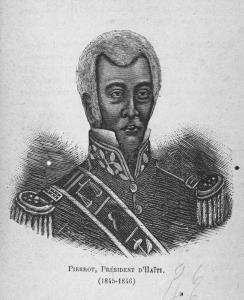
Pierrot was a North Province maroon leader who commanded a substantial insurgent force — Fick gives approximately 3,000 followers — and entered the politics of emancipation at the crucial moment of June 22, 1793, when he and Macaya arrived at Haut-du-Cap and were sworn into Sonthonax's army.
His acceptance of the emancipation offer shows that maroon leadership did not stand outside revolutionary politics but tested state promises against realities on the ground. Macaya served as his lieutenant, indicating a structured rather than a loose force. Later family traditions, confirmed to historian Étienne Charlier by Pierrot's grandson, connect this revolutionary figure to Cécile Fatiman and to the later President of Haiti (1845–1846) — though the identification remains probable rather than fully corroborated across the available sources.
In the ScholarshipHow historians have read this figure.
How historians and scholars have interpreted this figure across different analytical traditions.
Fick's Making Haiti situates Pierrot within the complex history of the North Province's maroon and insurgent communities — a leader who appears in the colonial archive as a figure who navigated between the maroon community's independence and the institutional demands of the revolutionary armies. Fick's methodology recovers Pierrot from the records of the North Province's administrative apparatus, situating him within the geography of maroon resistance that predated the 1791 revolution and that the emancipation period transformed rather than simply incorporated. His eventual integration into or conflict with the post-emancipation order traces the arc that maroon leaders consistently followed when the revolutionary armies claimed their territory and their fighters.
Pierrot's trajectory traces the arc that maroon leaders consistently followed — navigating between maroon community independence and institutional demands of the revolutionary armies, transformed by the emancipation period into something neither purely maroon nor simply revolutionary.
TimelineAcross the historical record.
- 1791
The Suisses
Connected in vault sources to the Suisses episode — the fate of enslaved auxiliaries whose abandonment revealed the limits of free-colored revolutionary commitments.
- 1793
Maroon Band Commander, North Province
Led approximately 3,000 maroon followers in the North Province; negotiated the emancipation offer with Sonthonax in June 1793 and brought his forces into the republican army.
RelationshipsPeople connected to this life.
- CommandedMacaya
Macaya served as Pierrot's lieutenant; Fick preserves this relationship, indicating a structured command rather than two parallel independent bands.
- Allied withLéger-Félicité Sonthonax
Accepted Sonthonax's emancipation offer on June 22, 1793; Pierrot and Macaya were sworn into the commissioners' army at Haut-du-Cap — a decisive moment linking maroon autonomy to official emancipation.
- Married toCécile Fatiman
Later family traditions preserved by Eddins connect Cécile Fatiman and Pierrot; Charlier's 1950s interview with their grandson confirmed Cécile had presided at Bois Caïman — the identification with the revolutionary Pierrot is probable but held provisionally.
- Related toBauvais
- Related toPierre Pinchinat
Pierre Pinchinat