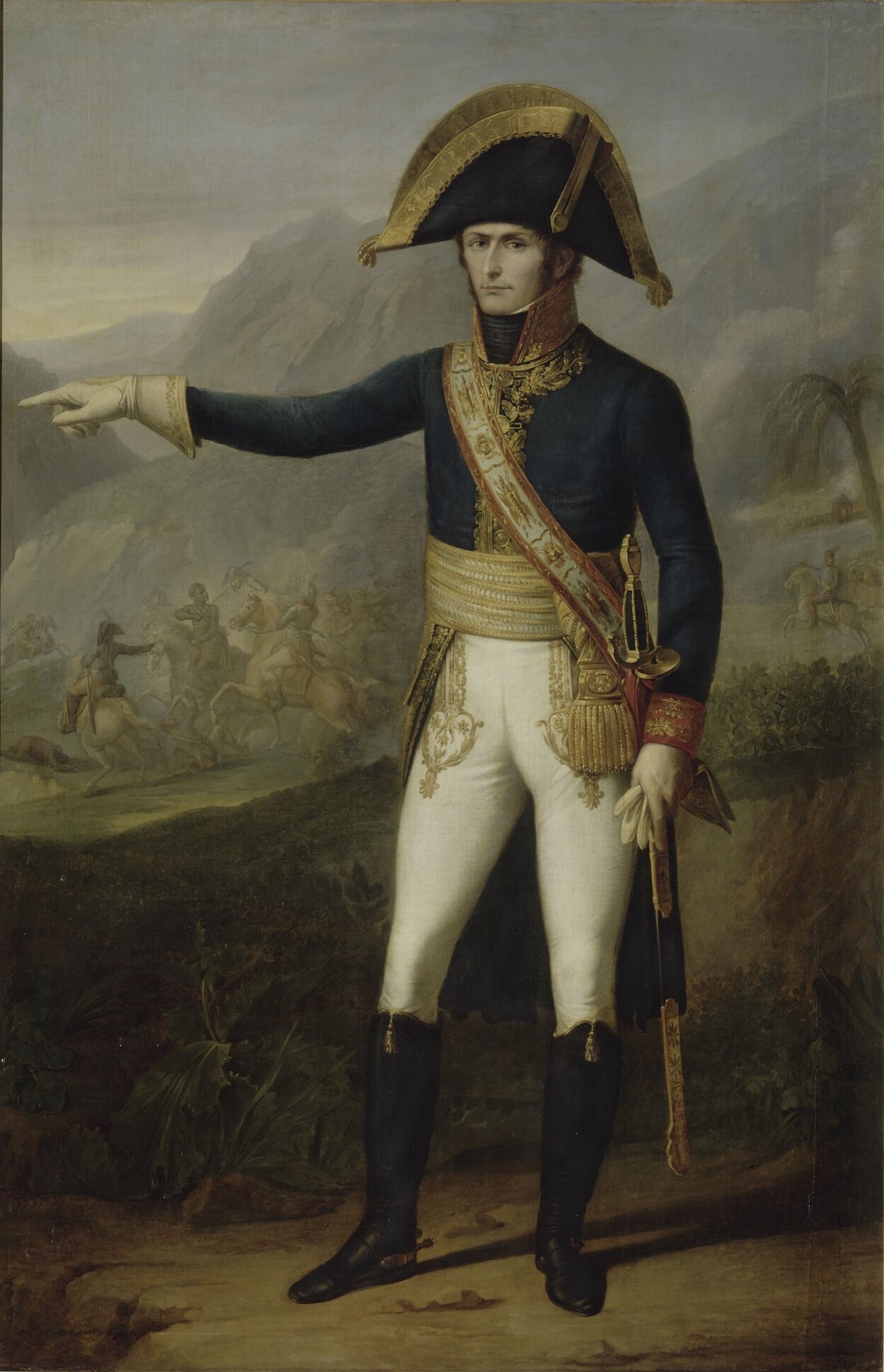
Charles Victor Emmanuel Leclerc was Napoleon Bonaparte's brother-in-law and commander of the largest French overseas expedition in history, dispatched in 1802 with secret orders to reassert French sovereignty, neutralize the Black generals, and restore slavery.
His strategy was premised on deception — arriving with assurances of liberty, neutralizing leaders like Toussaint, then reimposing bondage — but it collapsed against a population that had learned to read French promises correctly, and against a bossale resistance in the mountains that his command structure had no means of addressing. He arrested Toussaint under false pretenses in June 1802 and deported him to France, but the bossale commanders fought on independently; by September 1802 a single day's battle cost him 400 soldiers. Leclerc died of yellow fever on November 2, 1802, at thirty years old, leaving the expedition's catastrophe to his brutal successor Rochambeau. Napoleon's defeat in Saint-Domingue led directly to the sale of Louisiana to the United States.
In the ScholarshipHow historians have read this figure.
How historians and scholars have interpreted this figure across different analytical traditions.
Fick's Making Haiti reads the Leclerc expedition from below — through the perspective of the bossale commanders and the formerly enslaved population whose resistance his strategy of deception could not defeat. Fick's subaltern methodology makes visible the dimension of the expedition that Dubois's Atlantic framework and Bell's biographical focus on Toussaint tend to obscure: the independent bossale resistance in the mountains that operated entirely outside the command structure of the Black generals Leclerc was negotiating with. Sans Souci, Mavougou, and other bossale commanders who had never submitted to Toussaint's authority were not covered by any armistice Leclerc could negotiate with the creole generals — and their independent resistance proved decisive. Fick argues that it was this 'war within the war' — the bossale fighters who had nothing to negotiate and everything to fight for — that Leclerc's strategy fundamentally failed to account for.
Leclerc's deception strategy failed to account for the independent bossale resistance — commanders like Sans Souci who had never submitted to Toussaint operated outside any armistice Leclerc could negotiate, and their irreducible resistance proved the expedition's decisive obstacle.
Dubois's Avengers of the New World reads Charles Leclerc as the general sent by Napoleon to reverse emancipation and restore the plantation system — and whose expedition's failure proved that the formerly enslaved population of Saint-Domingue would fight and die rather than return to slavery. Dubois situates Leclerc within the broader Napoleonic project of restoring the colonial order across the Caribbean, linking his Saint-Domingue campaign to the simultaneous suppression of emancipation in Guadeloupe. Leclerc's correspondence with Napoleon, which documents his escalating desperation as the resistance intensified and disease devastated his army, appears in Dubois's account as the empire's admission that the revolution had created a military and political reality it could not undo. His death from yellow fever in 1802, before the final independence declaration, makes him the symbol of the expedition's failure.
Leclerc's escalating desperation, documented in his letters to Napoleon, proved that the revolution had created a military reality the empire could not undo — his campaign's failure made Haitian independence inevitable.
Bell's Toussaint Louverture: A Biography reads Leclerc through his complex relationship with Toussaint — the French general who initially negotiated with Toussaint, then engineered his capture through treachery, then found himself unable to translate military advantage into political stability. Bell's account is attentive to the epistolary record between Leclerc and Napoleon, which reveals how quickly the general's optimism about restoring colonial order collapsed into demands for more troops and more brutal suppression methods. Leclerc's transformation from confident expedition commander to desperate counterinsurgent tracks, in Bell's telling, the formerly enslaved population's escalating commitment to resistance as Leclerc's intentions became unmistakable.
Leclerc's transformation from confident commander to desperate counterinsurgent tracked the formerly enslaved population's escalating resistance — his capture of Toussaint through treachery accelerating rather than ending the insurrection.
TimelineAcross the historical record.
- 1802
Captain-General of Saint-Domingue
Commanded the 1802 French expedition with 20,000-40,000 soldiers; tasked with neutralizing Black leadership and restoring slavery; died of yellow fever in November 1802
- 1802
Leclerc Expedition
Commanded the 1802 French expedition to Saint-Domingue
RelationshipsPeople connected to this life.
- OpposedCharles Bélair
Sent Dessalines to capture and execute Charles Bélair when he turned against the French in August 1802
- OpposedSans Souci
Issued the July 4, 1802 arrest order for Sans Souci; the bossale commander's riposte on September 15 killed 400 French soldiers in a single day
- Allied withJean-Jacques Dessalines
Dessalines initially submitted to Leclerc and was used to hunt other rebels; later defected and led independence
- OpposedToussaint Louverture
Arrested Toussaint under false pretenses in June 1802 and deported him to Fort de Joux in France, where he died