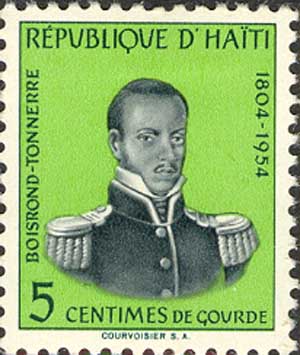
Louis Félix Boisrond-Tonnerre was Dessalines's secretary and the principal drafter of Haiti's 1804 Declaration of Independence.
Born in Torbek, Saint-Domingue, and educated in France under the guardianship of Julien Raimond, he came from the most prominent free-colored family in the South Province. When Dessalines rejected a legally-worded draft by his first secretary Chareron, he chose Boisrond-Tonnerre after hearing him declare the document should be written 'with a white man's skin for parchment, his skull for an inkstand, his blood for ink, and a bayonet for a quill. ' He was also likely the main author of the 1805 Constitution. He was executed in 1806, the same year as Dessalines's assassination.
In the ScholarshipHow historians have read this figure.
How historians and scholars have interpreted this figure across different analytical traditions.
Dubois's Avengers of the New World reads Boisrond-Tonnerre's Declaration as the culminating textual act of the revolutionary process — the document in which the violence of the preceding years was crystallized into a founding political philosophy. Dubois situates the Declaration within the broader context of how Dessalines and his collaborators constructed Haitian sovereignty out of the ruins of the colonial order, choosing rupture over the conciliatory rhetoric that other founders might have preferred. Boisrond-Tonnerre's authorship appears in Dubois's account as the literary expression of Dessalines's political program: not a republic that reformed colonialism but one that destroyed and replaced it, from its legal foundations upward.
The Declaration's rhetorical violence expressed Dessalines's political program — not a republic that reformed colonialism but one that destroyed and replaced it from its legal foundations upward.
Gaffield's The Haitian Declaration of Independence: Creation, Context, and Legacy places Boisrond-Tonnerre as the primary author of Haiti's 1804 Declaration of Independence — the figure whose oral demand that the document be written 'with the skin of a white man as parchment, his skull as an inkwell, his blood as ink, and a bayonet as pen' captured the Declaration's intended rupture with both French colonialism and the Enlightenment universalism that had failed to include Haiti. Gaffield's documentary research establishes Boisrond-Tonnerre's authorship beyond dispute and reads the Declaration's rhetorical violence as a considered political choice: a text that announced Haiti not as a republic seeking admission to the community of nations but as a revolutionary force that had permanently repudiated the colonial order. His authorship makes him the literary architect of Haitian sovereignty's founding self-presentation.
Boisrond-Tonnerre's declaration — 'written with the skin of a white man as parchment' — was a considered political choice: announcing Haiti not as a republic seeking admission to the nations but as a revolutionary force permanently repudiating the colonial order.
TimelineAcross the historical record.
- 1803
Secretary to Dessalines
Drafted the Declaration of Independence and likely the 1805 Constitution; served as primary secretary to the illiterate general
- 1804-01-01
Haitian Declaration of Independence
Principal drafter of the French-language Declaration of Independence (January 1, 1804)